3 Tips for Teaching Multiplicative Comparisons in Fourth Grade
Multiplicative comparisons are a key part of fourth-grade math, and they can be pretty challenging for students to grasp at first. While many kids can handle basic multiplication facts, understanding statements like "Maria has 4 times as many stickers as Ben" takes a deeper understanding of multiplication as a way to compare, not just repeated addition.
If your students find multiplicative comparisons tough, don't worry—you’re not alone! Here are three friendly strategies to help your students build confidence and get a solid grasp of this important skill for fourth grade.
1. Start with Visual Models
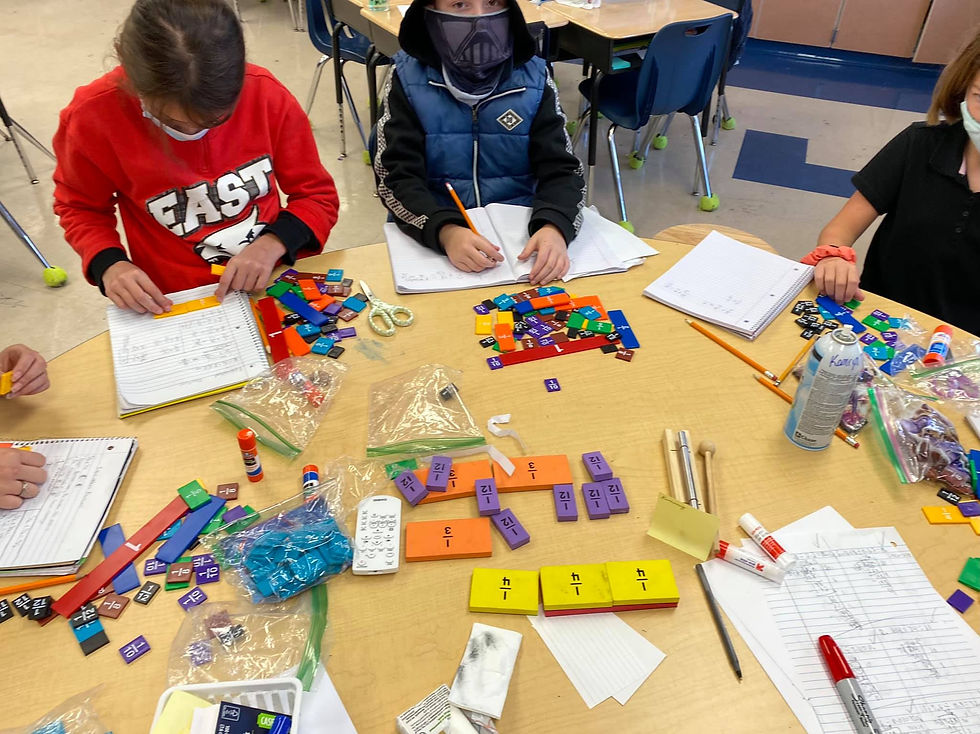
Before you introduce equations, try helping students picture what multiplicative relationships look like.
For example, Ben has 3 blocks and Maria has 4 times as many blocks.

This way, students can see that Maria has four groups of Ben's blocks. Using visual tools like tape diagrams, bar models, and arrays can make the concept of "times as many" much clearer. Encourage students to sketch quick drawings when they face multiplication comparison problems — these visuals can make the leap from real-world understanding to abstract equations much smoother.
2. Focus on the Multiplicative Comparison Language

Many students' errors stem from a misunderstanding of the vocabulary used in comparison problems.
Spend time discussing phrases such as:
Times as many
Times as much
Twice as many
Three times as many
Half as many
Half as much
Create an anchor chart with examples and non-examples. Have students practice identifying the comparison before solving the problem.
For example:
"Sarah has 5 books. Liam has 3 times as many books as Sarah."
Ask students:
Who has the smaller amount?
Who has the larger amount?
What does "3 times as many" mean?
Helping students analyze the language first often prevents common mistakes.

3. Use Real-World Problem Solving
Students learn best when they can connect math to real-life situations.
Create comparison problems involving:
Sports cards
Money earned at a garage sale
Classroom supplies
Pets
Favorite books
For example:
"Emma earned $4 at a garage sale. Ayden earned 4 times as much as Emma."
Students can use multiplication to determine that Ayden earned $16.
As students become more comfortable, introduce multi-step comparison problems that require reasoning and critical thinking. These types of problems encourage students to explain their thinking and justify their answers.

Bringing It All Together
Teaching multiplicative comparisons can be a smooth and enjoyable journey. When you incorporate visual models, highlight comparison language, and offer meaningful real-world practice, students will more easily grasp multiplication as a way of making comparisons. With regular practice, they'll start to recognize how quantities relate to one another and feel more confident solving problems.
Looking for ready-to-use activities on multiplicative comparisons that align with 4.OA.1 and 4.OA.2? Feel free to explore my Multiplicative Comparisons Worksheets and Activities resource—it's packed with engaging exercises that help students practice multiplication comparisons, develop their problem-solving skills, and strengthen their mathematical reasoning.